How to choose a Cookie Banner for your website
If you've reached this article, you're certainly searching and wondering: What is the best cookie banner for your website, and how do you choose among the many options on the market? What are the criteria for this choice, and what are the strengths and weaknesses of each option? Well, we're here to help you because this decision needs to be well thought out!
Therefore, below we have listed the answers into key points that should be carefully analyzed.
- Why do I need this banner, really?
- But cookies are anonymous, so why all this?
- Legislation and Language.
- LGPD and the cookie banner, technical aspects of the Law.
- Design.
- Truth.
- Detailed Purposes.
- Freedom of choice.
- Blocking third-party cookies.
- Price
- Integrations.
First of all, does your website REALLY need an LGPD Cookie banner?
What do you mean? I'm already in this article to choose a cookie software, and you still want to tell me who actually needs the LGPD Cookie banner?
Exactly! Because there are many people who come to us to install the cookie banner on a website that simply does not use cookies. Seriously! Sometimes it seems like our banner is synonymous with website quality (okay, I confess, I agree), but there are limits.
It's like buying sunscreen for a nighttime stroll or mosquito repellent for diving.
The key point is confusing for many!
- Just because many websites are using it doesn't mean you need to as well!
- Pay attention to other legal bases that can support your business, in addition to consent.
- The key question: If you don't use cookies on your website, why have a cookie banner? In times of such complex legislation, less is more!
Here, we have highlighted some points from the LGPD to support our reasoning:
Article 8 addresses how the controller should request the data subject's consent. The first and most important rule is that the consent clauses must be separate from others, allowing the data subject to have a clear understanding of what they are consenting to.
Article 8 - § 2: The burden of proving that consent has been obtained in accordance with this Law lies with the controller.
_What does this mean? _
As the controller (your website), you must keep a record of all consents obtained, and these must be stored and documented.
Because at any time, data subjects have the right to request such records and any data you may have about them.
Refer to Article 19:
Article 19: Confirmation of the existence of personal data or access to personal data shall be provided upon request by the data subject:
_
I - in a simplified format, immediately;_ or
II - through a clear and complete statement indicating the origin of the data, the absence of a record, the criteria used, and the purpose of the processing, subject to trade and industrial secrets, provided within a period of up to 15 (fifteen) days from the date of the data subject's request.
-
Personal data shall be stored in a format that facilitates the exercise of the right of access.
-
Information and data may be provided, at the data subject's discretion. § 3. The processing of personal data based on defective consent is prohibited. § 4. Consent must relate to specific purposes, and generic authorizations for the processing of personal data shall be void. § 5. Consent may be revoked at any time by the data subject's express manifestation, by means of a free and facilitated procedure, without prejudice to the processing carried out under the previously given consent until the request for elimination, as provided for in item VI of the main section of Article 18 of this Law.
If you're not familiar with the digital world, let me explain to you with the most popular phrase from privacy policies ("Cookies are small pieces of text that are stored in your browser when you access a website on the internet.")
With this information from cookies, companies can do a lot, and I mean a lot! They can accurately profile your psychology and cross-reference this information with extremely personal data, known in the market as data enrichment or "data farming."
The logic is always very similar: Browser -> cookie -> personal data (email, phone) -> person/registration -> CPF (Brazilian individual taxpayer registry) -> income, IRPF (Brazilian income tax return), marital status
Several companies do this, and virtually all of those that have tags installed on their websites can somehow convert this information and target any individual specifically. Whether it's directly through their own database (Google), or by cross-referencing with third-party databases (such as Serasa).
In other words:
Cookies are not anonymous but rather anonymized.
This is an excellent variable to consider when looking for a cookie banner! Questions like: Does it support multiple languages, can that be an advantage? But, before that, does it accept multiple legislations?
For example, if your website is Brazilian and someone accesses it from Italy, it wouldn't be enough for the banner to be in Italian. The visitor is actually under the jurisdiction of the GDPR, unless the LGPD has more "private" provisions in those specific areas (as required by the visitor's country's law).
In other words, just because your site has multiple languages and versions doesn't mean that all the legislations are correctly implemented and complied with regarding the cookie banner. Is it clearer now?
Pay attention to compliance with the applicable legislations, especially for your target audience! Language and accessibility are crucial, but not the only factors when it comes to foreign accesses.
Now that we understand the context of the law, the complexities of cookies, and the parallel legislations that may influence the use of the Cookie Banner on your website, let's discuss some key points that will help you make this choice.
- Design
Why design when we're talking about technical aspects? Precisely because of that, after all, what are the main metrics of a website, an e-commerce? How do you analyze the conversion from visitors to leads and then to sales? Is Bounce Rate a concern? What are the KPIs of your site? Does usability and visitor experience matter?
Yes, they matter A LOT!
Thus, look for a cookie banner with refined and responsive design that allows you to customize colors, logos, and placement on the site in a way that harmonizes with the overall structure of the site. Don't just throw a senseless banner in the middle of the visitor's screen; respect the attention the visitor is giving you!
Be cautious with designs that occupy the entire screen! We understand that the law requires clear and assertive communication, and many are overwhelmed by the uncertainties in the market. However, you shouldn't disturb the visitor or act impulsively because of that!
We know how every second counts in capturing visitors' attention, so make it count!
Do you really want to use a banner that steals attention instead of fulfilling a simple and even basic role required by the law?
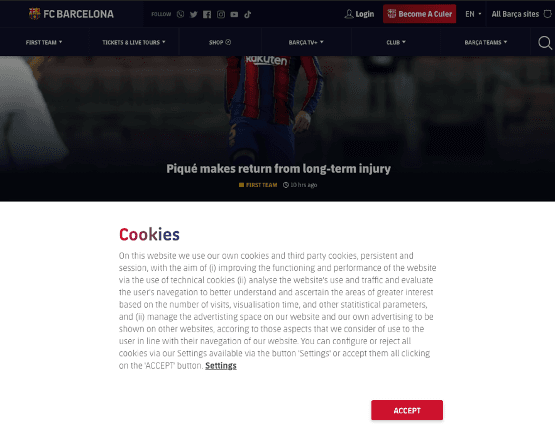
This Barcelona F.C. banner is like having ten players blocking the goal...
- Transparency
I may sound sensationalistic, but I dare say:
"Most of the cookie plugins and banners we see on the internet are just fake buttons. Yes, digital components that don't record or organize anything."
In addition to the "fakeness" of these mentioned points, always use assertive and direct language. Don't try to be "cool" or trendy. Of course, using too much legal jargon can push people away.

Not to mention that if I have no way to refuse, how would it block then? So, in the end, it's the same thing, don't you agree?
This is one of the crucial points we consider in a good cookie banner. According to LGPD, consent must be given for specific purposes. Therefore, a simple "OK" or even "Accept" without the option to explore my choices and understand their purposes and legal bases can be somewhat coercive.
Consent is not a salvation or a general acceptance. It is the formalization of acceptance for that specific purpose presented.

The General Data Protection Law (LGPD) lists a series of legal bases through which companies can use data with ease. If you have chosen consent for your company, use it with respect and always value the privacy of your data subjects.
There is no better or stronger legal basis. Instead, choose the one that best fits your business model and market. Similarly, a cookie banner should understand the context in which consent will be communicated and collected, and should provide visitors with the freedom to choose fully, partially, or not at all.
Always look for cookie banners that break down the listing of tags and cookies into categories and subcategories. This is essential to demonstrate that a particular purpose is presented within category "X," and visitors can freely choose whether to accept it or not.
The cookie banner is not just an interactive button; it must have authority over the behavior of other tags used on the website, authorizing or blocking their firing based on the consent collected during that visitor's session.
For example, the Google Analytics tag should only be fired when the visitor accepts the statistical category of tags. Before that, the notice informs and waits for visitor interaction.
For more information on how to configure the AdOpt Cookie Banner to enable automatic blocking of third-party tags, see our tutorial.
The price of a cookie banner should be:
Low prices that do not eat into your marketing budget. If there is a free plan, even better! The cookie banner only solves a part of the law's compliance, and it's likely that you will need other services or consultations in the future. Therefore, don't spend too much of your budget on this product.
A cookie banner does not cover all the obligations regulations like the GDPR, CCPA, LGPD... for example.
If you have other internal processes that use personal data, you will need to use other controls and even systems for that management.
The cookie banner should take care of the "digital gates" and reinforce the legal basis of consent.
How?
By recognizing and categorizing all users with their choices of total opt-in, partial opt-in, or opt-out and sending these requests directly to the Data Protection Officer (DPO), or even systems like CRM, ERP...
Look for cookie banners that offer billing with scalability parameters. In other words, they should have little to no impact initially, and as your website grows and your audience expands, you will pay for that processing power.
Additionally, the volume and value tiers should be broad enough to accommodate any seasonality, so you don't
Before you launch, follow the 7 steps to a GDPR-compliant cookie banner and check your setup against the 5 common cookie consent mistakes. To see a complete platform, read about the AdOpt CMP.
Tags
Related posts

Florida FDBR and Cookies: All You Need to Know
Everything you need to know about the Florida Digital Bill of Rights (FDBR): who must comply, the $1 billion threshold, 7 consumer rights, FIPA vs FDBR explained, penalties, and cookies.

IOWA ICDPA and Cookies: All you need to Know
Iowa ICDPA explained: the longest response deadline of all US state privacy laws (90 days), 90-day cure period, opt-out for sensitive data, limited deletion scope, no right to correct, and how it compares to UCPA, VCDPA, and OCPA.

AdOpt CMP
AdOpt CMP: Google-certified consent platform with prior blocking, granular choices, encrypted logs, and GTM/Consent Mode

Colorado CPA: Cookies Policy
What the Colorado CPA requires from your Cookies Policy: mandatory Universal Opt-Out Mechanism from July 2024, targeted advertising definition, dark pattern rules, and the 24-month consent refresh.

Montana MTCDPA: Privacy Policy
Learn what your MTCDPA Privacy Policy must include after Montana's SB 297 amendments from the conspicuous "privacy" hyperlink and last-updated date requirements to sale disclosures, minor protections, and how to keep your notice operationally aligned with your stack.

Why Give Consent on Every Website I Visit?
Have you ever noticed that every time you sign up for a service to access information or register on a website for purchases, you need to give consent? If you're wondering why you have to give consent on every website you visit, you'll find the answer here.

7 Steps to GDPR-Compliant Cookie Banners in 2025
Learn the essential steps for creating GDPR-compliant cookie banners in 2025, ensuring user consent and privacy protection.

Utah UCPA and Cookies: All you need to know
Utah UCPA explained: the most business-friendly US state privacy law, dual threshold requirement, opt-out for sensitive data, no right to correct, guaranteed 30-day cure period, and key differences from other state laws.

5 Signs Your Website Needs an Cookie Consent Strategy
How does your website handle LGPD? What strategies does it use to comply with the General Data Protection Law? Have you thought about using a cookie notice but don't know if your site has cookies or if it's enough? If you can't answer these questions, be cautious! Your page may be exposed to fines and other sanctions.

California CPRA: DSAR and Privacy Portal
California CPRA DSAR guide: new rights to correct and limit SPI, opt-out without multiple steps, GPC as valid opt-out, 12-month minor rule, private right of action, and CPPA enforcement.

Texas TDPSA and Cookies: All You Need to Know
Your website have users accessing from Texas? So be ready… the Texas Data Privacy and Security Act is here to shake things up. Don't worry; we've got your back. This guide will walk you through everything you need to know to ensure your website complies with the new regulations.

Virginia VCDPA: Cookies Policy
What the Virginia VCDPA requires from your Cookies Policy: targeted advertising disclosure, consent standards, tracker categories, opt-out mechanisms, and the 30-day cure period explained.
GDPR Legal Basis: An Introduction
In this article, we'll explore the GDPR foundations and provide practical insights from the basics to more advanced concepts of its legal basis.

LGPD: An Opportunity for Digital Marketing Agencies!
Have you ever thought that your marketing agency could find a great business opportunity in LGPD? Well, unlike what many think, it brings changes that can accelerate the demand for the services of these companies.

Connecticut CTDPA: DSAR Privacy Portal
How to handle DSARs under the Connecticut CTDPA: 5 consumer rights, opt-outs without mandatory authentication, 60-day appeal deadline, 15-day consent revocation, and AG-only enforcement.
Google Consent Mode: Beginner to Advanced Guide.
Google Consent Mode (GCM) is nothing more than a way for you to integrate the consent you collect from your visitors into Google technologies. In this way, upon receiving this consent information, collection can only occur with authorization, thus complying with the legislation and having direct evidence of compliance as defense for both you and Google.

The Impact of Cookie Banners on Your E-commerce - LGPD
Having a cookie banner on your brand's website has become indispensable for many. However, for e-commerce websites, it has practically become an obligation to have one. This is because this type of website has a technological composition in which cookies are a structural part. Login flow, items in the shopping cart, recommendation showcases, remarketing... Most of them rely on cookies.
Colorado CPA and Cookies: All You Need to Know
The Colorado Consumer Privacy Act went into effect July 1, 2023 (CPA). CPA is a vital piece of legislation designed to protect the privacy of residents in Colorado. Understanding its requirements is essential for any business operating in the state. This act is all about giving control back to the consumers regarding their personal data. But what does this mean for you and your business, especially when it comes to managing cookies on your website?

Oregon OCPA and Cookies: All You Need to Know
Everything about the Oregon OCPA: who must comply, the payment transaction exclusion, 25% revenue threshold, derived data in scope, GPC requirement from January 2026, and elimination of the cure period.

Key Differences between LGPD and GDPR and the Impact on Internet Cookies
While both regulations share the goal of safeguarding individuals' rights regarding the processing of their personal data, there are some important differences between them. It is crucial to understand these distinctions and their implications, particularly in the context of internet cookies.

10 Marketing Processes You Should Rethink under the LGPD!
In the end, our goal has never been to predict doom for companies or to be part of the LGPD's Apocalypse Cavalry. But, since we've been in the market for some time, these kinds of issues always catch our attention when we start data mapping and having conversations with colleagues.
IOWA ICDPA: DSAR and Privacy Portal
Iowa ICDPA DSAR guide: 90-day response deadline, 45-day extension, 60-day appeal process, limited deletion scope, opt-out from data sales, targeted advertising disclosure requirement, and 90-day cure period.

5 Common Cookie Consent Mistakes Hurting Your Compliance
Discover the 5 common **cookie consent mistakes** that risk your **compliance** and learn how to avoid heavy **fines**. Simplify your **data privacy** strategy using a reliable **[Cookie notice/banner](https://goadopt.io/en/blog/why-the-cookie-banner/)**.

Understand the legal bases of the LGPD
At the beginning of everything are the legal bases of the LGPD, that is, the legal grounds (legitimate reasons) why companies not only can, but must access customer data in order to do their jobs well.

LGPD and Cookies all do you need to know?
In this article, you will have a great introduction to the topic, as well as various other variations that revolve around the subject: Cookies and LGPD.
Oregon OCPA: Cookies Policy
What the Oregon OCPA requires from your Cookies Policy: opt-out link, GPC from January 2026, opt-out without authentication, derived data in scope, teen protections, and the elimination of the cure period.

Why are cookie banners everywhere?
Want to understand why there are cookie banners on every website you visit today? This article is for you!
GDPR and Cookies all you need to know
Understanding the General Data Protection Regulation (GDPR) and its impact on cookies is essential. So, let's break it down, step by step.

California CCPA: DSAR Privacy Portal
How to handle DSARs under the California CCPA/CPRA: 7 consumer rights, 45-day deadline, toll-free number required, 12-month lookback, private right of action for breaches, and CPPA enforcement.
Oregon OCPA: Privacy Policy
What the Oregon OCPA requires from your Privacy Policy: actively monitored contact channel, detailed third-party descriptions, derived data in scope, GPC from January 2026, and the elimination of the cure period.
Montana MTCDPA: DSAR Policy
Rights, Policy and how to understand about the DSAR Montana MTCDPA

Fines in LGPD - What are they, amounts, and compliance deadlines
In this article, we will answer all your questions regarding fines under the LGPD (Brazil's General Data Protection Law).

Everything about the Brazilian LGPD - General Data Protection Law.
All the important information about the General Data Protection Law - LGPD: what it is, why it exists, how it works, when it came into force, who it applies to, potential fines, steps for compliance, and its legal principles.
IOWA ICDPA: Cookies Policy
What the Iowa ICDPA requires from your Cookies Policy: opt-out for data sales and targeted advertising, opt-out model for sensitive data, no GPC requirement, no specific link text required, and the 90-day cure period.

Utah UCPA: Privacy Policy
What the Utah UCPA requires from your Privacy Policy: five mandatory elements, opt-out model for sensitive data, no retention periods required, no active contact channel mandate, and the guaranteed 30-day cure period.
California CCPA: Privacy Policy
What the California CCPA/CPRA requires from your Privacy Policy: 12-month lookback, annual updates, Do Not Sell link, sensitive PI disclosures, toll-free number, and the 7 consumer rights.
Florida FDBR: Cookies Policy
What the Florida FDBR requires from your Cookies Policy: targeted advertising across affiliated sites, opt-out for sensitive data and voice recognition, dark patterns, and tripled penalties.

LGPD for marketing | A practical guideline.
Every day, millions of users generate data on the web, which is used by companies around the globe to improve their offerings. Therefore, in 2018, a law was created to regulate the use of personal data by companies, and this directly impacts digital marketing. We're talking about LGPD.
Connecticut CTDPA and Cookies: All You Need to Know
The Connecticut Data Privacy Act (CTDPA) is a state regulation designed to protect the privacy of Connecticut residents. It also regards cookies, so in this article we will help you understand all about this new privacy regulation.
Florida FDBR: DSAR Privacy Portal
How to handle DSARs under the Florida FDBR: 7 consumer rights, two required submission channels, 45-day deadline with only 15-day extension, tripled penalties for children, and compliance guide.

New Hampshire NHDPA: DSAR Privacy Portal
What is a DSAR under NHDPA? Complete guide to consumer rights, response deadlines, and building a compliant Privacy Portal for your site.

What is the difference between cookies, local storage, and session storage?
Despite cookies being more well-known, what is the main difference between cookies and session storage and local storage? Why choose one over the other? This article will help you with these doubts!
Connecticut CTDPA: Privacy Policy
What the Connecticut CTDPA requires from your Privacy Policy: active email contact, opt-out link, 15-day consent revocation, opt-out preference signal from January 2025, and teen protections.
Florida FDBR: Privacy Policy
What the Florida FDBR requires from your Privacy Policy: annual updates, 6 mandatory content categories, specific notices for sensitive and biometric data sales, and the 7 consumer rights.
California CCPA: Cookies Policy
What the California CCPA/CPRA requires from your Cookies Policy: Do Not Sell or Share link, GPC compliance, sale vs sharing distinction, sensitive PI opt-out, and annual updates.
Explore AdOpt
Autor
João Bruno
12 Sep 2023
AdOpt


Relevant posts

What is a privacy policy?
Colorado CPA and Cookies: All You Need to Know

Tennessee TIPA and Cookies: All You Need to Know
Florida FDBR and Cookies: All You Need to Know
Texas TDPSA and Cookies: All You Need to Know
Google Consent Mode: Beginner to Advanced Guide.
Axeptio Strengthens its International Expansion with the Acquisition of AdOpt
Oregon OCPA and Cookies: All You Need to Know
Utah UCPA and Cookies: All you need to know

How to choose a Cookie Banner for your website


Address: 7345 W Sand Lake Road, Ste 210 Office 5898 Orlando, FL 32819
15 Rue du Général Campredon, 34000 Montpellier, France
207 Rue de Bercy, 75012 Paris, France
EIN: 86-3965064
Phone: +1 (407) 768-3792
AdOpt
Resources
Product
Certifications