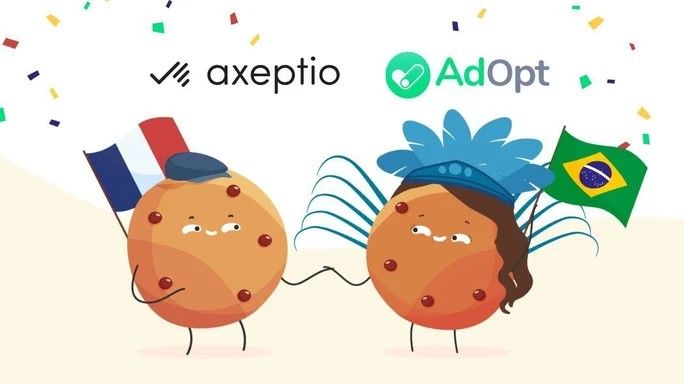
Axeptio Strengthens its International Expansion with the Acquisition of AdOpt
On February 13, 2025, Axeptio, a leader in consent management solutions, announced the acquisition of AdOpt, one of the leading players in the Brazilian market. This strategic move is part of Axeptio's international expansion dynamics, which, after opening a branch in Canada, continues its development in new markets.

With over 216 million inhabitants, Brazil represents a vast market with a growing demand for consent management solutions. LGPD - brazilian data protection law, inspired by the European GDPR, imposes strict obligations on companies in the collection and management of user consent. However, there is still a strategic space for European players to fully meet the expectations of the Brazilian market.
"Rather than create a subsidiary ex nihilo, **we decided to join forces with AdOpt**, a company that shares our values and our desire to become the trusted partner that brings together the interests of users and companies on the web," — Romain Bessuges-Meusy, CEO of Axeptio.
Axeptio, a pioneer in the compliance sector, already helps companies worldwide to comply with key data protection regulations: GDPR (Europe), nFADP (Switzerland), Law 25 (Quebec), and CCPA (California). Thus, entering the Brazilian market was a natural step to help businesses meet the requirements of LGPD.
Founded in the United States in 2021, the company expanded its operations in Brazil starting in 2023, with the opening of a local subsidiary. AdOpt is a consent solution that is currently present on more than 50,000 websites worldwide. Its positioning combines self-service with personalized and humanized support, serving influential clients such as Caixa Econômica, Nike, Reebok, LEGO, CROCS, Ajinomoto, Kipling...
“Joining Axeptio is a fantastic opportunity to amplify our impact and extend our mission **beyond Brazil**. We share the same philosophy: putting users at the center of the consent experience, with **solutions that are both easy to use, friendly and powerful**. Together, we will continue to help businesses create positive consent experiences. ” — Adonis Batista, CEO of AdOpt.
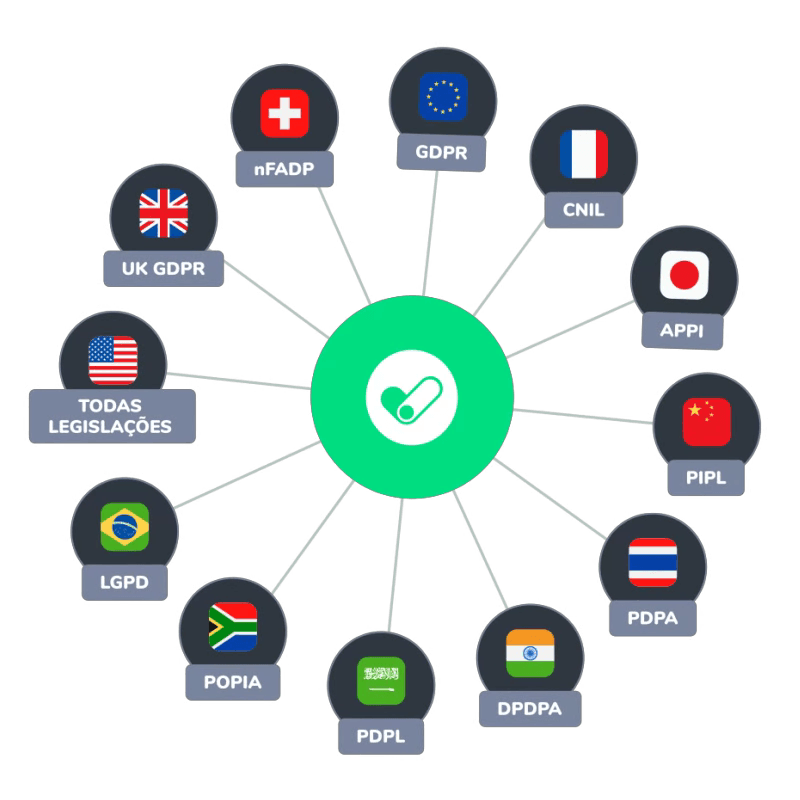
AdOpt is not limited to Brazil: in addition to LGPD, its solution covers the requirements of GDPR, CCPA, and other international regulations in over 30 countries and languages. This global reach makes AdOpt a strategic player for Axeptio, which aims to support the brand’s growth far beyond the Brazilian market.
"In fact, when we arrived in Brazil, we went for a coffee and **the barista immediately recognized the logo on João Bruno’s T-shirt, COO of AdOpt**. This level of brand awareness is rare in our sector and proves that AdOpt has succeeded in creating a strong, identifiable and appreciated brand" — Romain Bessuges-Meusy, CEO of Axeptio.

The partnership between Axeptio and AdOpt is based on a shared vision regarding consent management: meeting the needs of businesses and users to provide an seamless and engaging consent experience. Additionally, both companies share the same perspective: focus on the user and design to make compliance ever more seamless and enjoyable.
"We're entering a maturing phase in the CMP market. In this context, synergies between players make sense, especially geographically. **AdOpt is a local champion in Brazil. Axeptio is a champion in Europe and Canada.** Together, we'll unite our brands around a common vision: to make the web a better place to live, placing at the heart of the user experience the ability and freedom to choose whether or not to share one's data, without it being a burden" — Romain Bessuges-Meusy, CEO of Axeptio.
By partnering with Axeptio, a Google CMP partner (Gold status) and certified by TCF of IAB Europe and IAB Canada, AdOpt will benefit from its expertise and ability to integrate the latest technological innovations, such as Consent Mode v2 and TCF 2.2.
Thanks to this alliance, AdOpt clients will have more flexibility, with the option to access advanced features and a broader range of services offered by Axeptio.
More than a simple acquisition, the alliance between Axeptio and AdOpt represents a commitment to deeply root itself in local ecosystems, leveraging the expertise and reputation of existing players.
By integrating a Brazilian leader into its growth dynamics, Axeptio ensures infrastructures adapted to Brazil's regional specifics, confirming its ability to build sustainable and multi-regional growth. This evolution opens up new opportunities and strategic alliances with companies that share the same vision for the future of the web.
The acquisition of AdOpt by Axeptio has generated significant media attention, highlighting the relevance of this move in strengthening Axeptio's presence in Latin America.
*For example, Exchange Wire's article points out that Axeptio, a leading European CMP and Google Gold Partner, has acquired AdOpt, Brazil’s top consent management platform, strengthening its presence in Latin America. This strategic move merges Axeptio’s global regulatory expertise (GDPR, LGPD, CCPA, etc.) with AdOpt’s deep understanding of the Brazilian market. The acquisition reflects a shared commitment to user-centric, regulation-compliant consent experiences and highlights the growing importance of local integration in global data privacy strategies.
*In Le Mag J&A's article, Axeptio, an European leader in digital consent management, has acquired AdOpt, a prominent Brazilian CMP serving over 50,000 websites, including major brands like Nike and LEGO.
This move strengthens Axeptio’s expansion into Latin America, aligning with Brazil’s stringent LGPD framework. The acquisition merges AdOpt’s local expertise with Axeptio’s global compliance and technology capabilities, aiming to deliver scalable, user-friendly consent solutions. Backed by Joffe & Associés, the deal reflects a shared vision of transparent, adaptable consent experiences and reinforces Axeptio’s strategy to localize compliance infrastructure while pursuing international growth.

*According to the news portal Isai, Axeptio, a leading European consent management platform, has raised €3.5 million from ISAI, Evolem, and Ovni Capital to accelerate its international expansion. With over 50,000 websites using its user-centric solution, Axeptio stands out by addressing "consent fatigue" through a transparent, intuitive, and regulation-compliant platform.
The investment will support team growth and global market penetration, reinforcing Axeptio’s mission to make consent a trust-building opportunity rather than a legal burden. Founded in 2017, Axeptio continues to prioritize respectful user experiences while scaling compliance solutions across 40+ countries.

To understand the category, read what a consent management platform is. To see the product today, read about the AdOpt CMP. And for the Consent Mode integration mentioned above, see the Google Consent Mode guide.
Tags
Related posts

AdOpt CMP
AdOpt CMP: Google-certified consent platform with prior blocking, granular choices, encrypted logs, and GTM/Consent Mode

Colorado CPA: Cookies Policy
What the Colorado CPA requires from your Cookies Policy: mandatory Universal Opt-Out Mechanism from July 2024, targeted advertising definition, dark pattern rules, and the 24-month consent refresh.

Montana MTCDPA: Privacy Policy
Learn what your MTCDPA Privacy Policy must include after Montana's SB 297 amendments from the conspicuous "privacy" hyperlink and last-updated date requirements to sale disclosures, minor protections, and how to keep your notice operationally aligned with your stack.

7 Steps to GDPR-Compliant Cookie Banners in 2025
Learn the essential steps for creating GDPR-compliant cookie banners in 2025, ensuring user consent and privacy protection.

Utah UCPA and Cookies: All you need to know
Utah UCPA explained: the most business-friendly US state privacy law, dual threshold requirement, opt-out for sensitive data, no right to correct, guaranteed 30-day cure period, and key differences from other state laws.

5 Signs Your Website Needs an Cookie Consent Strategy
How does your website handle LGPD? What strategies does it use to comply with the General Data Protection Law? Have you thought about using a cookie notice but don't know if your site has cookies or if it's enough? If you can't answer these questions, be cautious! Your page may be exposed to fines and other sanctions.

California CPRA: DSAR and Privacy Portal
California CPRA DSAR guide: new rights to correct and limit SPI, opt-out without multiple steps, GPC as valid opt-out, 12-month minor rule, private right of action, and CPPA enforcement.

Texas TDPSA and Cookies: All You Need to Know
Your website have users accessing from Texas? So be ready… the Texas Data Privacy and Security Act is here to shake things up. Don't worry; we've got your back. This guide will walk you through everything you need to know to ensure your website complies with the new regulations.

Virginia VCDPA: Cookies Policy
What the Virginia VCDPA requires from your Cookies Policy: targeted advertising disclosure, consent standards, tracker categories, opt-out mechanisms, and the 30-day cure period explained.
GDPR Legal Basis: An Introduction
In this article, we'll explore the GDPR foundations and provide practical insights from the basics to more advanced concepts of its legal basis.

LGPD: An Opportunity for Digital Marketing Agencies!
Have you ever thought that your marketing agency could find a great business opportunity in LGPD? Well, unlike what many think, it brings changes that can accelerate the demand for the services of these companies.

Connecticut CTDPA: DSAR Privacy Portal
How to handle DSARs under the Connecticut CTDPA: 5 consumer rights, opt-outs without mandatory authentication, 60-day appeal deadline, 15-day consent revocation, and AG-only enforcement.

Google Consent Mode: Beginner to Advanced Guide.
Google Consent Mode (GCM) is nothing more than a way for you to integrate the consent you collect from your visitors into Google technologies. In this way, upon receiving this consent information, collection can only occur with authorization, thus complying with the legislation and having direct evidence of compliance as defense for both you and Google.

The Impact of Cookie Banners on Your E-commerce - LGPD
Having a cookie banner on your brand's website has become indispensable for many. However, for e-commerce websites, it has practically become an obligation to have one. This is because this type of website has a technological composition in which cookies are a structural part. Login flow, items in the shopping cart, recommendation showcases, remarketing... Most of them rely on cookies.

Oregon OCPA and Cookies: All You Need to Know
Everything about the Oregon OCPA: who must comply, the payment transaction exclusion, 25% revenue threshold, derived data in scope, GPC requirement from January 2026, and elimination of the cure period.

Key Differences between LGPD and GDPR and the Impact on Internet Cookies
While both regulations share the goal of safeguarding individuals' rights regarding the processing of their personal data, there are some important differences between them. It is crucial to understand these distinctions and their implications, particularly in the context of internet cookies.

IOWA ICDPA: DSAR and Privacy Portal
Iowa ICDPA DSAR guide: 90-day response deadline, 45-day extension, 60-day appeal process, limited deletion scope, opt-out from data sales, targeted advertising disclosure requirement, and 90-day cure period.

5 Common Cookie Consent Mistakes Hurting Your Compliance
Discover the 5 common **cookie consent mistakes** that risk your **compliance** and learn how to avoid heavy **fines**. Simplify your **data privacy** strategy using a reliable **[Cookie notice/banner](https://goadopt.io/en/blog/why-the-cookie-banner/)**.
Oregon OCPA: Cookies Policy
What the Oregon OCPA requires from your Cookies Policy: opt-out link, GPC from January 2026, opt-out without authentication, derived data in scope, teen protections, and the elimination of the cure period.

GDPR and Cookies all you need to know
Understanding the General Data Protection Regulation (GDPR) and its impact on cookies is essential. So, let's break it down, step by step.

California CCPA: DSAR Privacy Portal
How to handle DSARs under the California CCPA/CPRA: 7 consumer rights, 45-day deadline, toll-free number required, 12-month lookback, private right of action for breaches, and CPPA enforcement.
Oregon OCPA: Privacy Policy
What the Oregon OCPA requires from your Privacy Policy: actively monitored contact channel, detailed third-party descriptions, derived data in scope, GPC from January 2026, and the elimination of the cure period.
Montana MTCDPA: DSAR Policy
Rights, Policy and how to understand about the DSAR Montana MTCDPA

Fines in LGPD - What are they, amounts, and compliance deadlines
In this article, we will answer all your questions regarding fines under the LGPD (Brazil's General Data Protection Law).
IOWA ICDPA: Cookies Policy
What the Iowa ICDPA requires from your Cookies Policy: opt-out for data sales and targeted advertising, opt-out model for sensitive data, no GPC requirement, no specific link text required, and the 90-day cure period.

Utah UCPA: Privacy Policy
What the Utah UCPA requires from your Privacy Policy: five mandatory elements, opt-out model for sensitive data, no retention periods required, no active contact channel mandate, and the guaranteed 30-day cure period.

Florida FDBR: Cookies Policy
What the Florida FDBR requires from your Cookies Policy: targeted advertising across affiliated sites, opt-out for sensitive data and voice recognition, dark patterns, and tripled penalties.
Florida FDBR: DSAR Privacy Portal
How to handle DSARs under the Florida FDBR: 7 consumer rights, two required submission channels, 45-day deadline with only 15-day extension, tripled penalties for children, and compliance guide.

New Hampshire NHDPA: DSAR Privacy Portal
What is a DSAR under NHDPA? Complete guide to consumer rights, response deadlines, and building a compliant Privacy Portal for your site.
Connecticut CTDPA: Privacy Policy
What the Connecticut CTDPA requires from your Privacy Policy: active email contact, opt-out link, 15-day consent revocation, opt-out preference signal from January 2025, and teen protections.
Florida FDBR: Privacy Policy
What the Florida FDBR requires from your Privacy Policy: annual updates, 6 mandatory content categories, specific notices for sensitive and biometric data sales, and the 7 consumer rights.

GDPR, LGPD, and CCPA: What Are These Laws, Similarities, and Differences
LGPD, GDPR, and CCPA are data privacy regulations. In this article, we discuss their similarities and differences for practical application.

Virginia VCDPA and Cookies: All you need to know
Everything you need to know about the Virginia Consumer Data Protection Act (VCDPA): who must comply, consumer rights, cookie requirements, penalties, and how to get your site in compliance.
California CCPA and Cookies: All You Need to Know
Everything about the California CCPA and CPRA: who must comply, the $25M threshold, 7 consumer rights, CCPA vs CPRA explained, the Do Not Sell link, CPPA enforcement, and cookies.

How to choose a Cookie Banner for your website
What are the criteria for this choice, and what are the strengths and weaknesses of each option? Well, we're here to help you because this decision needs to be well thought out!

What is a privacy policy?
A privacy policy is a document that outlines how an organization collects, uses, discloses, and manages a customer's data. It's essential for building trust with users and complying with legal requirements. However, if you're not familiar with it, don't worry as we're here to help you.

How long can we ignore LGPD?
LGPD is in effect. Despite that, there are still many companies ignoring it, but is that possible? How long can we ignore LGPD?

California CPRA: Privacy Policy
What the California CPRA requires from your Privacy Policy: SPI category, two mandatory links, data retention periods, sharing disclosure, right to correct, GPC, and minor protections.
New Hampshire NHDPA: Privacy Policy
Learn what your Privacy Policy must contain under the NHDPA. We break down the 8 mandatory elements and how to comply with New Hampshire's data privacy law.

How to Choose a CMP (Consent Management Platform)?
Using a CMP (Consent Management Platform) is a great way to make efforts to adapt to new privacy regulations like GDPR, LGPD, DPDPA, CCPA and more...

Tenesse TIPA: Privacy Policy
Learn what your TIPA Privacy Policy must include to comply with the Tennessee Information Protection Act from consumer rights and targeted advertising disclosures to the NIST affirmative defense, appeal mechanisms, and how to keep your notice aligned with your operational program.
Tenesse TIPA: Cookies Policy
Learn how to build a defensible TIPA Cookies Policy for Tennessee compliance covering consent architecture, opt-out requirements, the NIST affirmative defense, and how your cookie banner, privacy notice, and vendor management must work together under the Tennessee Information Protection Act.
Montana MTCDPA: Cookies Policy
Learn about how to apply Montana MTCDPA Cookies Policy in your site
New Hampshire NHDPA: Cookies Policy
Cookies Policy under NHDPA explained. Discover what's mandatory, dark patterns to avoid, and how to implement legal cookie consent.

How does a cookie banner operate?
Here is a step-by-step explanation of how consent registration works in AdOpt.
Explore AdOpt
Autor
João Bruno
15 Apr 2025
AdOpt


Relevant posts
What is a privacy policy?
Colorado CPA and Cookies: All You Need to Know
Tennessee TIPA and Cookies: All You Need to Know
Florida FDBR and Cookies: All You Need to Know
Texas TDPSA and Cookies: All You Need to Know
Google Consent Mode: Beginner to Advanced Guide.
Axeptio Strengthens its International Expansion with the Acquisition of AdOpt
Oregon OCPA and Cookies: All You Need to Know
Utah UCPA and Cookies: All you need to know
How to choose a Cookie Banner for your website


Address: 7345 W Sand Lake Road, Ste 210 Office 5898 Orlando, FL 32819
15 Rue du Général Campredon, 34000 Montpellier, France
207 Rue de Bercy, 75012 Paris, France
EIN: 86-3965064
Phone: +1 (407) 768-3792
AdOpt
Resources
Product
Certifications