How to delete cookies and cache in Chrome and other browsers?
Tired of the ads from that site you visited following you around?
Is your computer running slow when accessing a particular website?
Want to delete all cookies from a specific service or site?
One of the alternatives is to delete Cookies and Cache from your browsers!
We'll provide you with step-by-step instructions for each of these options. But before that, to make things clear:
The term cache is basically the storage of frequently used data or processes, which are stored for faster future access, thus saving time and unnecessary use of hardware processing.
This functionality is widely used in various types of devices and software, such as browsers, for example. You know when you first access a website and it takes longer to load than your favorite site that you visit every day?
That's precisely the practical application of cache! Your browser has saved various information and page structures in a reserved environment so that you don't have to download them again on future visits. This makes everything faster, especially for those with weaker internet or weak signals.
In short, cookies serve the same function as cache in terms of storing information, but in different formats and processes. Many of the services we access daily use cookies for other functionalities such as remembering your browser as a returning client, keeping items you "left in the shopping cart," recording information about your browsing, etc.
In this article, you can find a more in-depth explanation.
In other words, both cookies and cache store information in your computer's or mobile device's memory. As a result, they often overload the storage and slow down the system. That's why various browsers have rules to delete all cookies every three months, for example, or are starting to block third-party cookies to avoid this unnecessary accumulation.
However, sometimes the browser's cleaning cycle is not enough.
So learn from AdOpt how to delete your browser's cache and cookies:
Sometimes, when you're experiencing issues with using an online service or accessing a website, the technical team asks you to clear the browser cache.
To get rid of the data stored on your computer when you access a website, you don't need to go to the Google Chrome Preferences. Just use the shortcut below:
Control + Shift + Del
Command + Shift + Del
After that, simply select the items you want to delete: cache, cookies, history... and DONE!
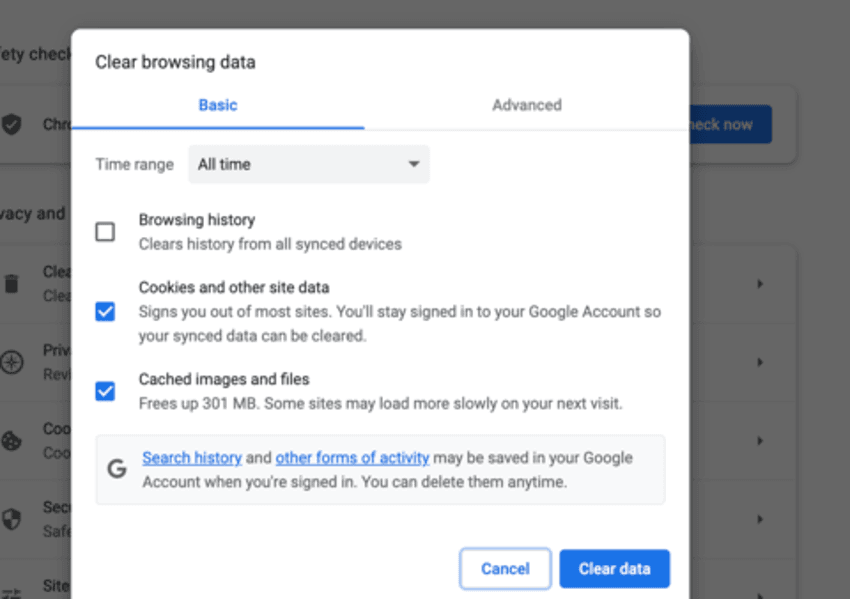
If you're using Google Chrome,
- Click on the three dots in the upper right corner to open a configuration menu.
- Go to More Tools.
- Then click on Clear browsing data. A new window, as shown in the image below, will open, and in it, you just need to choose what you want to clear: - Cookies and other site data - Cached images and files.
- After selecting the options, click the "Clear browsing data" button.
Done!
Then click on Clear browsing data. A new window, as shown in the image below, will open, and in it, you just need to choose what you want to clear: - Cookies and other site data - Cached images and files.
After selecting the options, click the "Clear browsing data" button.
Done!
By following these instructions, your computer will be lighter, and your browsing experience will improve.
But be prepared because all saved logins and access will also be cleared, requiring you to sign in again and "prove that you are you."
If your browser is Internet Explorer, for any version, follow the steps below:
- Access the menu on the right Settings (indicated by the gear icon as shown below).
- Click on Security > Delete browsing history. (A window will open, showing your browsing history).
- By clicking the Delete button, you can delete all the data saved by the **Internet Explorer **browser.
For versions of the **Mozilla Firefox **browser, follow the simple cleaning process below:
- Menu Firefox > Preferences.
- Choose the Privacy option.
- Select the option Clear your recent history: *Here, you can determine the time period to be deleted and the respective details to select.
- To finish, simply click Clear Now.
- Done! You can now continue browsing peacefully!
For Safari users, the process to clear cookies is also straightforward.
Click on the Preferences option.
Select the Privacy option > Remove all website data.
After this click, confirm your decision.
Tags
Related posts
5 Common Cookie Consent Mistakes Hurting Your Compliance
Discover the 5 common **cookie consent mistakes** that risk your **compliance** and learn how to avoid heavy **fines**. Simplify your **data privacy** strategy using a reliable **[Cookie notice/banner](https://goadopt.io/en/blog/why-the-cookie-banner/)**.

The Differences Between Data Controller and Data Processor - LGPD
Now that we have the data flow within your company, we need to highlight 2 aspects of LGPD that will help you determine the extent of your responsibility in relation to the many points listed in the company. I'm talking about the difference between Data Controller and Data Processor.

7 Steps to GDPR-Compliant Cookie Banners in 2025
Learn the essential steps for creating GDPR-compliant cookie banners in 2025, ensuring user consent and privacy protection.

5 Signs Your Website Needs an Cookie Consent Strategy
How does your website handle LGPD? What strategies does it use to comply with the General Data Protection Law? Have you thought about using a cookie notice but don't know if your site has cookies or if it's enough? If you can't answer these questions, be cautious! Your page may be exposed to fines and other sanctions.

How long can we ignore LGPD?
LGPD is in effect. Despite that, there are still many companies ignoring it, but is that possible? How long can we ignore LGPD?

LGPD: An Opportunity for Digital Marketing Agencies!
Have you ever thought that your marketing agency could find a great business opportunity in LGPD? Well, unlike what many think, it brings changes that can accelerate the demand for the services of these companies.

What is a privacy policy?
A privacy policy is a document that outlines how an organization collects, uses, discloses, and manages a customer's data. It's essential for building trust with users and complying with legal requirements. However, if you're not familiar with it, don't worry as we're here to help you.

Key Differences between LGPD and GDPR and the Impact on Internet Cookies
While both regulations share the goal of safeguarding individuals' rights regarding the processing of their personal data, there are some important differences between them. It is crucial to understand these distinctions and their implications, particularly in the context of internet cookies.

10 Marketing Processes You Should Rethink under the LGPD!
In the end, our goal has never been to predict doom for companies or to be part of the LGPD's Apocalypse Cavalry. But, since we've been in the market for some time, these kinds of issues always catch our attention when we start data mapping and having conversations with colleagues.

LGPD and Cookies all do you need to know?
In this article, you will have a great introduction to the topic, as well as various other variations that revolve around the subject: Cookies and LGPD.

Google Consent Mode: Beginner to Advanced Guide.
Google Consent Mode (GCM) is nothing more than a way for you to integrate the consent you collect from your visitors into Google technologies. In this way, upon receiving this consent information, collection can only occur with authorization, thus complying with the legislation and having direct evidence of compliance as defense for both you and Google.

LGPD & COOKIES - ANPD Releases "Guidance on Cookies and Personal Data Protection"
On October 18, 2022, the National Data Protection Authority (ANPD) released the "Guidance on Cookies and Personal Data Protection." Highly anticipated by professionals in the field, this document is of utmost importance as it examines various applicable legal scenarios and establishes the requirements to be observed in the case of cookie usage.

LGPD for marketing | A practical guideline.
Every day, millions of users generate data on the web, which is used by companies around the globe to improve their offerings. Therefore, in 2018, a law was created to regulate the use of personal data by companies, and this directly impacts digital marketing. We're talking about LGPD.
GDPR Legal Basis: An Introduction
In this article, we'll explore the GDPR foundations and provide practical insights from the basics to more advanced concepts of its legal basis.

Best practices in tag categorization
It's time to talk about one of the most impactful tasks, both for the company and for the visitors of your websites: tag categorization. But why is it so impactful? What is the relevance of this configuration and how can it affect us? It is precisely because of these common questions we receive from our clients that we have written this article on best practices in tag categorization.

How to choose a Cookie Banner for your website
What are the criteria for this choice, and what are the strengths and weaknesses of each option? Well, we're here to help you because this decision needs to be well thought out!

Fines in LGPD - What are they, amounts, and compliance deadlines
In this article, we will answer all your questions regarding fines under the LGPD (Brazil's General Data Protection Law).

Axeptio Strengthens its International Expansion with the Acquisition of AdOpt
Axeptio acquires Brazil's AdOpt, expanding global reach in consent management and LGPD compliance.

Why are cookie banners everywhere?
Want to understand why there are cookie banners on every website you visit today? This article is for you!

California CCPA and Cookies: All You Need to Know
Everything about the California CCPA and CPRA: who must comply, the $25M threshold, 7 consumer rights, CCPA vs CPRA explained, the Do Not Sell link, CPPA enforcement, and cookies.

Understand the meaning of the LGPD for your company
Surely you've already seen the predictions of fines and sanctions, processes. But, what does it mean to your company?

Everything about the Brazilian LGPD - General Data Protection Law.
All the important information about the General Data Protection Law - LGPD: what it is, why it exists, how it works, when it came into force, who it applies to, potential fines, steps for compliance, and its legal principles.

Understand the legal bases of the LGPD
At the beginning of everything are the legal bases of the LGPD, that is, the legal grounds (legitimate reasons) why companies not only can, but must access customer data in order to do their jobs well.

Oregon OCPA: Privacy Policy
What the Oregon OCPA requires from your Privacy Policy: actively monitored contact channel, detailed third-party descriptions, derived data in scope, GPC from January 2026, and the elimination of the cure period.

AdOpt CMP
AdOpt CMP: Google-certified consent platform with prior blocking, granular choices, encrypted logs, and GTM/Consent Mode

GDPR, LGPD, and CCPA: What Are These Laws, Similarities, and Differences
LGPD, GDPR, and CCPA are data privacy regulations. In this article, we discuss their similarities and differences for practical application.

Tips on how to notify users after a change on the Terms of Use.
Terms of Use are quite literally the contract established between you and the company offering that product or service in a digital manner. Therefore, not only their development but also any eventual changes require careful consideration.
What is the ideal privacy policy for your company?
Is there an ideal and _foolproof_ Privacy Policy? This is one of the most difficult questions to answer nowadays. Especially considering all the jurisprudence already established in Europe with the GDPR, the extensive history of cases, and the numerous tips we see in the market. Not to mention the judicial decisions that are already emerging in Brazil with the LGPD.

How to Choose a CMP (Consent Management Platform)?
Using a CMP (Consent Management Platform) is a great way to make efforts to adapt to new privacy regulations like GDPR, LGPD, DPDPA, CCPA and more...

GDPR and Cookies all you need to know
Understanding the General Data Protection Regulation (GDPR) and its impact on cookies is essential. So, let's break it down, step by step.
Explore AdOpt
Autor
João Bruno
16 May 2023
AdOpt


Relevant posts
What is a privacy policy?

Colorado CPA and Cookies: All You Need to Know

Tennessee TIPA and Cookies: All You Need to Know

Florida FDBR and Cookies: All You Need to Know

Texas TDPSA and Cookies: All You Need to Know
Google Consent Mode: Beginner to Advanced Guide.
Axeptio Strengthens its International Expansion with the Acquisition of AdOpt
Oregon OCPA and Cookies: All You Need to Know

Utah UCPA and Cookies: All you need to know
How to choose a Cookie Banner for your website


Address: 7345 W Sand Lake Road, Ste 210 Office 5898 Orlando, FL 32819
15 Rue du Général Campredon, 34000 Montpellier, France
207 Rue de Bercy, 75012 Paris, France
EIN: 86-3965064
Phone: +1 (407) 768-3792
AdOpt
Resources
Product
Certifications